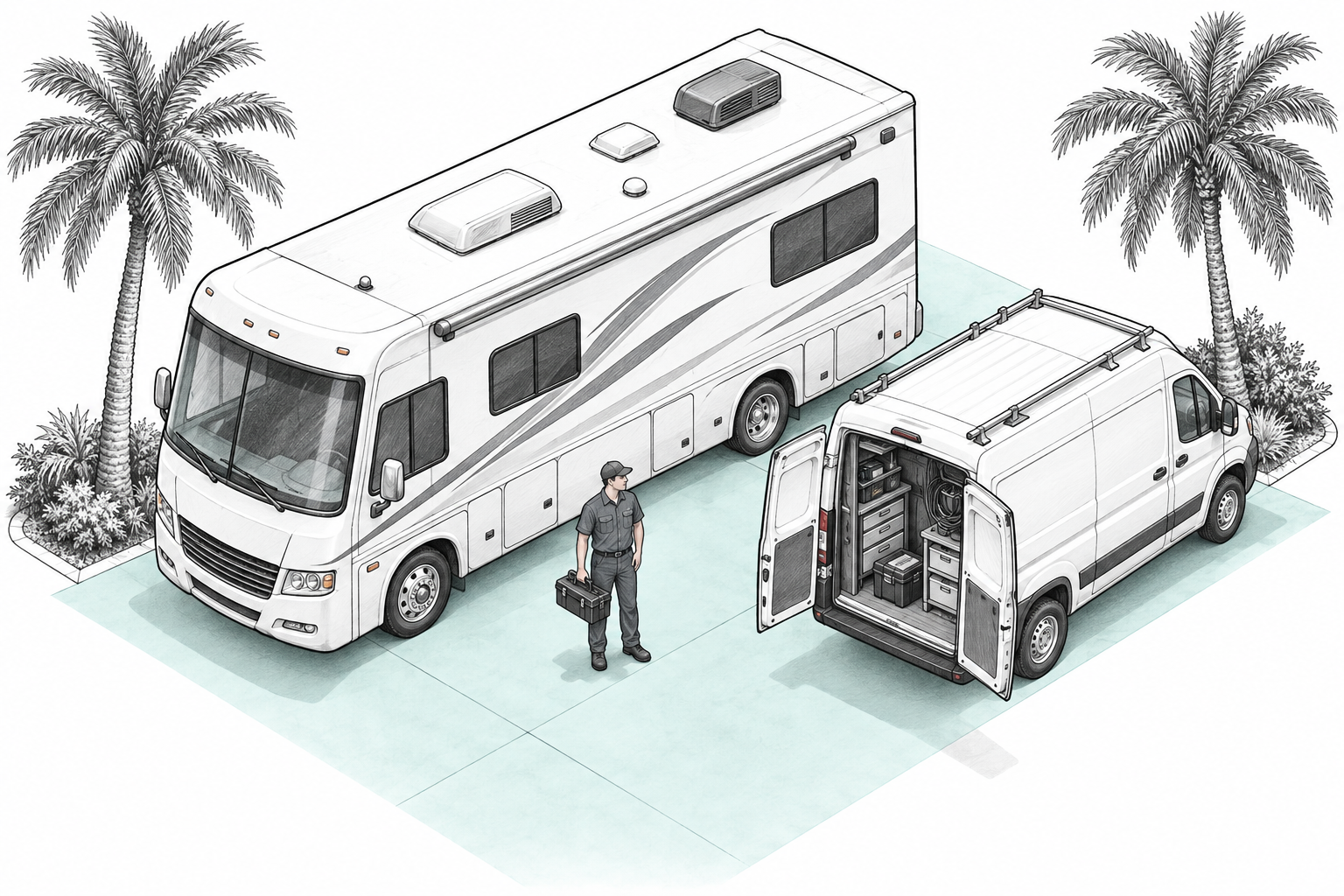
Pre-purchase and annual RV inspections in Central Florida follow a protocol that is meaningfully different from what a northern-state inspection covers, because the failure modes are different. The climate accelerates specific degradation pathways, and knowing where to look for Florida-specific damage is the difference between a useful inspection and one that misses the most likely problems.
The pre-purchase inspection in Central Florida must treat water intrusion as the primary concern. Florida's rainy season delivers more opportunities for roof sealant failure, slideout seal degradation, and window frame sealant failure to allow water entry than almost any other region. Our pre-purchase inspection protocol uses a calibrated moisture meter to probe every ceiling panel, every slideout header area, every floor junction, and every wall panel adjacent to windows and exterior doors.
In our experience inspecting rigs throughout the Winter Garden, Kissimmee, and Clermont market, roughly 40 percent of used RVs marketed as being in good condition have measurable moisture readings above the acceptable threshold in at least one location. This finding is not always a deal-breaker, but it changes the negotiation and affects the long-term ownership cost estimate significantly.
Annual safety inspections in Florida must cover propane system integrity with more thoroughness than is typical in a northern inspection. Florida's heat causes the rubber flex hoses that connect rigid propane lines to appliances to harden and crack faster than in cool climates.
A rubber flex hose behind the refrigerator or adjacent to the furnace that has surface cracks from heat and UV should be replaced, not documented and deferred - a cracked hose has no visible leak at ambient temperature but will weep at operating pressure when the appliance heats it. We pressure-test every propane system to 125 percent of operating pressure and hold the pressure for 10 minutes as part of every annual inspection, and we find at least one leak in approximately one in five inspections on rigs older than 8 years.
Tire condition inspection is a Florida-specific safety priority. Florida's high ambient temperatures and intense UV degrade tire sidewalls faster than in northern states. RV tires that look fine - adequate tread, no obvious flat-spotting - can have sidewall micro-cracks from ozone exposure and UV that are not visible without close examination.
A blowout from a UV-degraded sidewall at highway speed on I-4 is a serious accident risk. We check the DOT manufacture date code on every tire and flag any tire more than 5 years old for replacement recommendation, regardless of tread depth. Most tire manufacturers rate RV tires for 5 to 7 years in Florida conditions - the 10-year maximum they cite in their literature assumes cool-climate garage storage.
Electrically, the Florida annual inspection must include measurement of both shore power inlet quality and the chassis 12-volt system under load. Inlet voltage drop tests and a battery load test are quick measurements that reveal whether the shore power circuit and the battery bank are functioning at adequate capacity. A battery bank that tests acceptable at no-load but drops below 11 volts under the starting load of the AC compressor will cause nuisance faults throughout the entire control system - from the slide-out controller to the automatic leveling system to the refrigerator control board - and diagnosing these sequentially without identifying the weak battery bank wastes significant time and money.
| Brand / Model | Common Issue in Central Florida |
|---|
| Progressive Industries EMS (required check) | Verify calibration - EMS units should be tested annually with a known-accurate voltmeter; a unit that reads 0.5 volts high will fail to trigger on conditions that damage sensitive electronics |
| Kidde / First Alert LP detector | Sensor element service life is 5 to 7 years - a detector older than this range should be replaced regardless of whether it is alarming, as the sensor may no longer respond reliably to LP concentrations |
| Kidde CO detector | Same 5-to-7-year sensor life limit as the LP detector - CO is odorless and the detector is the only warning system; an expired sensor provides a false sense of security |
| Horizon LP regulator (2-stage) | Diaphragm hardening in Florida heat - a regulator older than 10 years should be replaced during inspection; a failing diaphragm can pass either too much or too little pressure and is not always detectable without a manometer test |
| Tie-down / cargo strap hardware | Corrosion at the ratchet mechanism from humidity exposure - a ratchet tie-down strap that binds or will not release smoothly should be replaced; a failed release on a loaded strap is a safety hazard |
| Trailer breakaway battery (Interstate, NAPA) | Complete discharge from non-use in a parked trailer - a breakaway battery that has sat discharged for a season may no longer hold charge; breakaway systems require a functional battery to stop the trailer in a separation event |