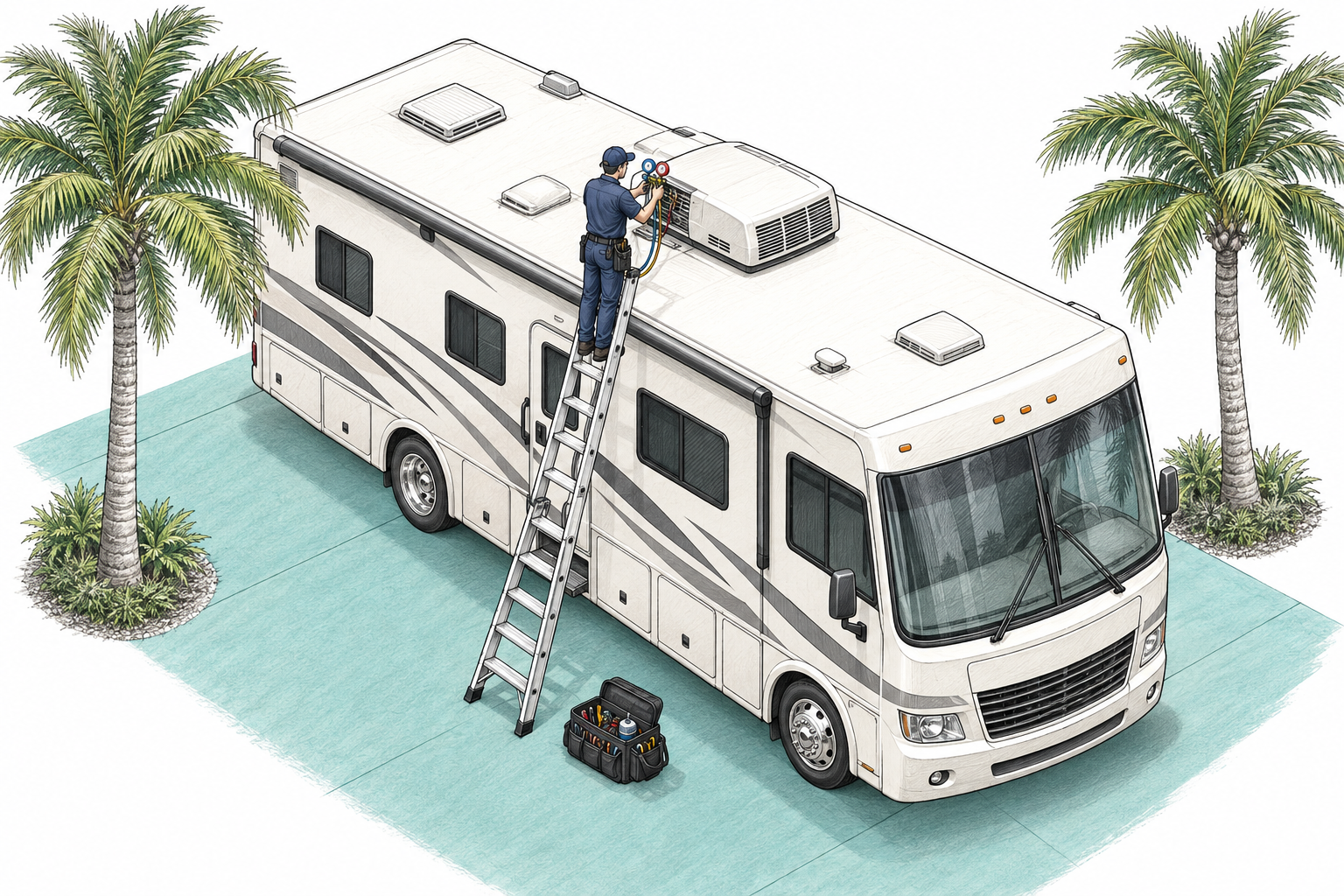
RV Repair Winter Garden provides mobile rv ceiling repair throughout Orange, Lake, and Osceola counties. Our certified technician comes to your wherever your RV is parked. Flat-rate pricing quoted before we start - no towing required.
Our certified mobile technicians provide rv ceiling repair throughout Winter Garden and all of Orange, Lake, and Osceola counties. We come to your wherever your RV is parked - no towing, no shop drop-off required.
Feat Ac Repair in Winter Garden, FLFeat Slide Out in Winter Garden, FL
Flat-rate pricing is given before any work begins. You approve the price, we do the work. Available 7 days a week, 7 AM to 8 PM.
RV ceiling fabric re-gluing runs $85 to $245 for a localized area. A full ceiling re-cover with new fabric runs $350 to $750 for a standard 30-foot interior. Water-damaged substrate repair behind the ceiling adds $150 to $450 depending on the damage extent.
RV ceiling fabric (headliner) is adhered with contact cement to a substrate. The adhesive fails from age, heat cycling, and moisture.
In Florida, humidity causes the adhesive to soften and release gradually. The fabric typically starts falling at the corners and edges, which are exposed to the most thermal movement.
If the fabric is intact (no tears, no mold, no water staining) and the substrate is dry and sound, regluing is the appropriate repair. Apply new contact cement to both surfaces, wait until tacky, and press firmly. If the fabric has shrunk from heat and no longer covers the full ceiling, replacement is needed.
3M Super 77 or Elmer's multi-purpose spray adhesive works well for light fabric re-attachment. For full re-covering, a heat-resistant contact cement like DAP Weldwood Applied to both surfaces creates a stronger bond that handles Florida's extreme summer temperatures better than spray adhesive alone.
Brown or yellow ceiling stains are dried mineral deposits and organic material from water that entered through the roof and wicked through the ceiling substrate. The stain location is close to but not necessarily directly below the roof leak - water travels along the substrate before dripping. Finding the leak source typically requires a roof inspection.
Expanding foam can fill voids in damaged foam-board substrate but does not restore structural rigidity. A better approach is to cut out the damaged section, allow the area to dry completely, and install new 1/2-inch foam board or 1/4-inch lauan before recovering with fabric. Spray foam shrinks over time and can create new voids.
For common RV headliner fabrics - typically a light beige or cream ribbed fabric - we carry stock that matches most production RV interiors from the last 15 years. Uncommon patterns or two-tone ceilings may require ordering from an RV upholstery supplier. We bring sample swatches to the quote visit.
Sharp objects, stress cracks from substrate movement, and insect damage (some beetles and moths bore small holes in RV headliner fabrics) are common causes. UV degradation over time makes the fabric brittle in RVs stored in Florida sun, allowing small movement cracks to propagate into tears.
Yes - for surface dirt, pollen, and light mildew, clean with a dilute fabric upholstery cleaner and a soft brush. Avoid saturating the fabric, as excess moisture weakens the adhesive bond and causes the fabric to sag again. For mold staining, a dilute bleach spray (10%) applied and dried is effective on intact fabric.
Condensation on the RV ceiling is caused by warm humid outdoor air meeting the cooler ceiling surface chilled by the air conditioner. This is a ventilation and insulation issue, not a roof leak.
Increasing vent fan use to improve air exchange reduces condensation. An RV ceiling vapor barrier that has separated from the substrate exacerbates the problem.
FAQ
Common Questions
RV ceiling fabric re-gluing runs $85 to $245 for a localized area. A full ceiling re-cover with new fabric runs $350 to $750 for a standard 30-foot interior. Water-damaged substrate repair behind the ceiling adds $150 to $450 depending on the damage extent.
RV ceiling fabric (headliner) is adhered with contact cement to a substrate. The adhesive fails from age, heat cycling, and moisture.
In Florida, humidity causes the adhesive to soften and release gradually. The fabric typically starts falling at the corners and edges, which are exposed to the most thermal movement.
If the fabric is intact (no tears, no mold, no water staining) and the substrate is dry and sound, regluing is the appropriate repair. Apply new contact cement to both surfaces, wait until tacky, and press firmly. If the fabric has shrunk from heat and no longer covers the full ceiling, replacement is needed.
3M Super 77 or Elmer's multi-purpose spray adhesive works well for light fabric re-attachment. For full re-covering, a heat-resistant contact cement like DAP Weldwood Applied to both surfaces creates a stronger bond that handles Florida's extreme summer temperatures better than spray adhesive alone.
Brown or yellow ceiling stains are dried mineral deposits and organic material from water that entered through the roof and wicked through the ceiling substrate. The stain location is close to but not necessarily directly below the roof leak - water travels along the substrate before dripping. Finding the leak source typically requires a roof inspection.
Expanding foam can fill voids in damaged foam-board substrate but does not restore structural rigidity. A better approach is to cut out the damaged section, allow the area to dry completely, and install new 1/2-inch foam board or 1/4-inch lauan before recovering with fabric. Spray foam shrinks over time and can create new voids.
For common RV headliner fabrics - typically a light beige or cream ribbed fabric - we carry stock that matches most production RV interiors from the last 15 years. Uncommon patterns or two-tone ceilings may require ordering from an RV upholstery supplier. We bring sample swatches to the quote visit.
Sharp objects, stress cracks from substrate movement, and insect damage (some beetles and moths bore small holes in RV headliner fabrics) are common causes. UV degradation over time makes the fabric brittle in RVs stored in Florida sun, allowing small movement cracks to propagate into tears.
Yes - for surface dirt, pollen, and light mildew, clean with a dilute fabric upholstery cleaner and a soft brush. Avoid saturating the fabric, as excess moisture weakens the adhesive bond and causes the fabric to sag again. For mold staining, a dilute bleach spray (10%) applied and dried is effective on intact fabric.
Condensation on the RV ceiling is caused by warm humid outdoor air meeting the cooler ceiling surface chilled by the air conditioner. This is a ventilation and insulation issue, not a roof leak.
Increasing vent fan use to improve air exchange reduces condensation. An RV ceiling vapor barrier that has separated from the substrate exacerbates the problem.
RV Problem? We Come to You.
Same-day service across Winter Garden and all of Central Florida. Guaranteed flat-rate pricing before we start.