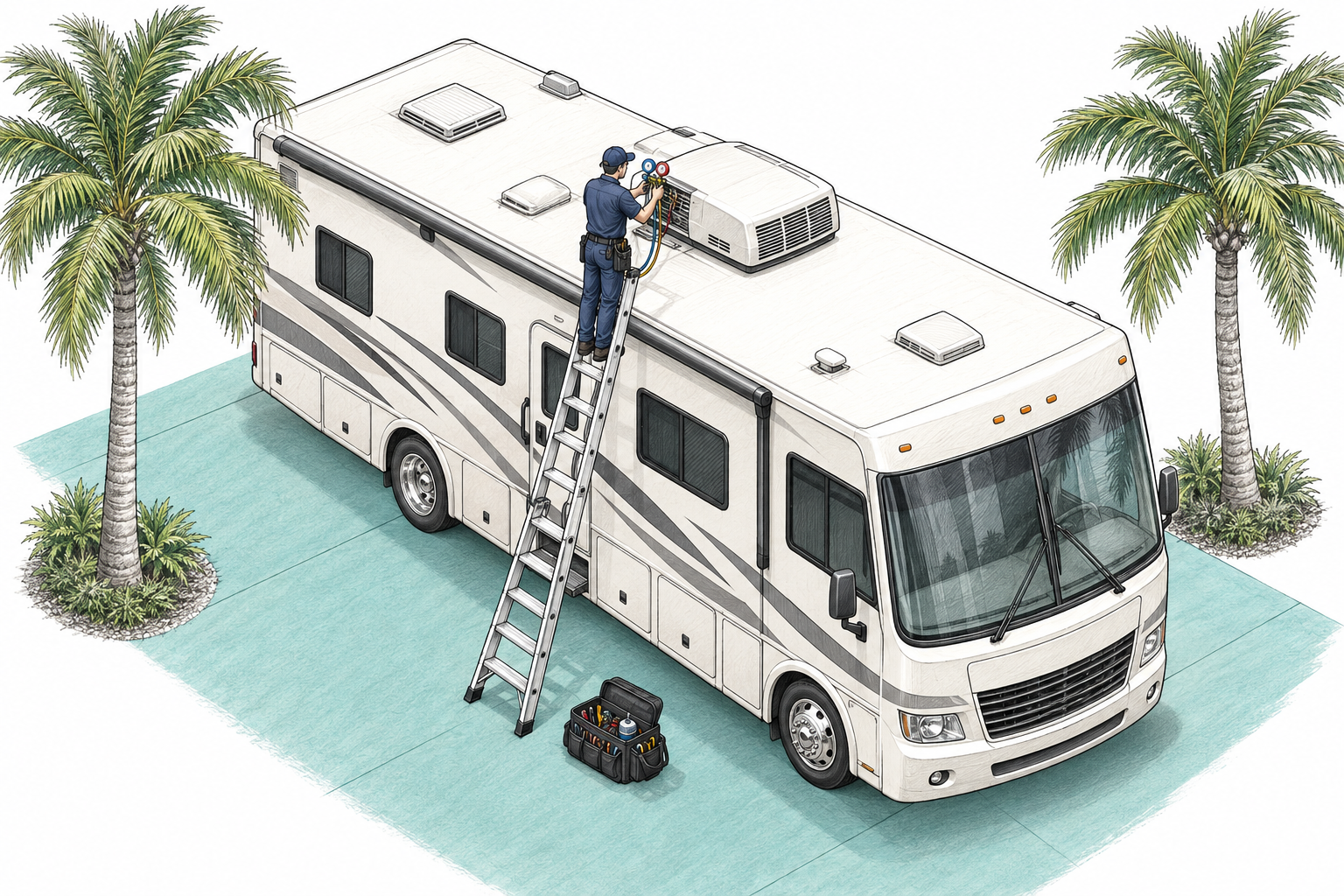
RV Repair Winter Garden provides mobile rv tank sensor repair throughout Orange, Lake, and Osceola counties. Our certified technician comes to your wherever your RV is parked. Flat-rate pricing quoted before we start - no towing required.
Our certified mobile technicians provide rv tank sensor repair throughout Winter Garden and all of Orange, Lake, and Osceola counties. We come to your wherever your RV is parked - no towing, no shop drop-off required.
Feat Ac Repair in Winter Garden, FLFeat Slide Out in Winter Garden, FL
Flat-rate pricing is given before any work begins. You approve the price, we do the work. Available 7 days a week, 7 AM to 8 PM.
Tank sensor replacement runs $65 to $165 per tank depending on sensor type. Probe-type replacement sensors are $45 to $95 plus labor. Some sensors can be cleaned and restored rather than replaced - cleaning service runs $65 to $95 per tank.
Tank sensor probes coat with waste solids, grease, toilet paper, and mineral deposits that stick to the probes and create a false electrical connection. This reads as 1/3, 2/3, or full regardless of actual tank level. It is the most common RV complaint and the primary reason correct tank treatment is so important.
Yes - for moderately coated sensors, enzymatic cleaning combined with agitation (the Geo Method or a commercial tank sensor cleaner like Clean Fixx) restores accurate readings in many cases. Heavily mineralized sensors in Florida's hard water may need replacement if cleaning doesn't restore function.
The most reliable fix is replacing standard probe sensors with magnetic float sensors mounted on the side of the tank wall. Float sensors do not touch the tank contents and cannot coat.
Brands like Tank-Tenders and Horst Miracle Sensors offer tank-exterior sensor replacement kits. Installation is done without entering the tank.
Tank sensor displays are a convenience, not a safety device. You can operate the RV without working sensors by monitoring tank fill on a schedule and using a water level stick through the toilet to check black tank level. However, repairing the sensors is preferable to guessing tank level - overfilling a tank while driving has unpleasant consequences.
Black tank sensors coat faster than gray tank sensors because of the solid waste and tissue exposure. If the gray tank sensors are accurate but black tank sensors are not, the black tank sensors need individual cleaning or replacement. The electrical resistance needed to trigger each level reading differs between black and gray, so treatment that works on one may not work on the other.
Most tank monitor systems can be tested by manually grounding each sensor probe with a wire and monitoring the display response. This confirms the display and wiring are functional and narrows the fault to the sensor probes themselves. This is a diagnostic tool, not a calibration; actual level verification requires known amounts of water.
Yes - external ultrasonic tank sensors like the SeeLevel II mount on the outside of the tank and measure content level through the tank wall using ultrasound. They work on most fiberglass and ABS tanks but not on aluminum or steel tanks. Installation requires access to the tank exterior and takes about 2 hours per tank.
Yes - Orange County municipal water has 200 to 300 ppm total dissolved solids. Calcium and magnesium in the water deposit on sensor probes over time, creating a mineral scale coating similar to limescale in a water heater. Annual vinegar rinse treatment of the gray tank helps prevent mineral sensor coating.
SeeLevel II is an external capacitive tank sensor system that reads through the tank wall and is completely immune to probe coating. It provides 1/8th-increment level readings rather than 1/3-increment readings of most OEM systems.
Upgrade cost is $185 to $350 installed for a 3-tank system. Worth it for full-timers who need reliable level data; optional for weekend users.
FAQ
Common Questions
Tank sensor replacement runs $65 to $165 per tank depending on sensor type. Probe-type replacement sensors are $45 to $95 plus labor. Some sensors can be cleaned and restored rather than replaced - cleaning service runs $65 to $95 per tank.
Tank sensor probes coat with waste solids, grease, toilet paper, and mineral deposits that stick to the probes and create a false electrical connection. This reads as 1/3, 2/3, or full regardless of actual tank level. It is the most common RV complaint and the primary reason correct tank treatment is so important.
Yes - for moderately coated sensors, enzymatic cleaning combined with agitation (the Geo Method or a commercial tank sensor cleaner like Clean Fixx) restores accurate readings in many cases. Heavily mineralized sensors in Florida's hard water may need replacement if cleaning doesn't restore function.
The most reliable fix is replacing standard probe sensors with magnetic float sensors mounted on the side of the tank wall. Float sensors do not touch the tank contents and cannot coat.
Brands like Tank-Tenders and Horst Miracle Sensors offer tank-exterior sensor replacement kits. Installation is done without entering the tank.
Tank sensor displays are a convenience, not a safety device. You can operate the RV without working sensors by monitoring tank fill on a schedule and using a water level stick through the toilet to check black tank level. However, repairing the sensors is preferable to guessing tank level - overfilling a tank while driving has unpleasant consequences.
Black tank sensors coat faster than gray tank sensors because of the solid waste and tissue exposure. If the gray tank sensors are accurate but black tank sensors are not, the black tank sensors need individual cleaning or replacement. The electrical resistance needed to trigger each level reading differs between black and gray, so treatment that works on one may not work on the other.
Most tank monitor systems can be tested by manually grounding each sensor probe with a wire and monitoring the display response. This confirms the display and wiring are functional and narrows the fault to the sensor probes themselves. This is a diagnostic tool, not a calibration; actual level verification requires known amounts of water.
Yes - external ultrasonic tank sensors like the SeeLevel II mount on the outside of the tank and measure content level through the tank wall using ultrasound. They work on most fiberglass and ABS tanks but not on aluminum or steel tanks. Installation requires access to the tank exterior and takes about 2 hours per tank.
Yes - Orange County municipal water has 200 to 300 ppm total dissolved solids. Calcium and magnesium in the water deposit on sensor probes over time, creating a mineral scale coating similar to limescale in a water heater. Annual vinegar rinse treatment of the gray tank helps prevent mineral sensor coating.
SeeLevel II is an external capacitive tank sensor system that reads through the tank wall and is completely immune to probe coating. It provides 1/8th-increment level readings rather than 1/3-increment readings of most OEM systems.
Upgrade cost is $185 to $350 installed for a 3-tank system. Worth it for full-timers who need reliable level data; optional for weekend users.
RV Problem? We Come to You.
Same-day service across Winter Garden and all of Central Florida. Guaranteed flat-rate pricing before we start.