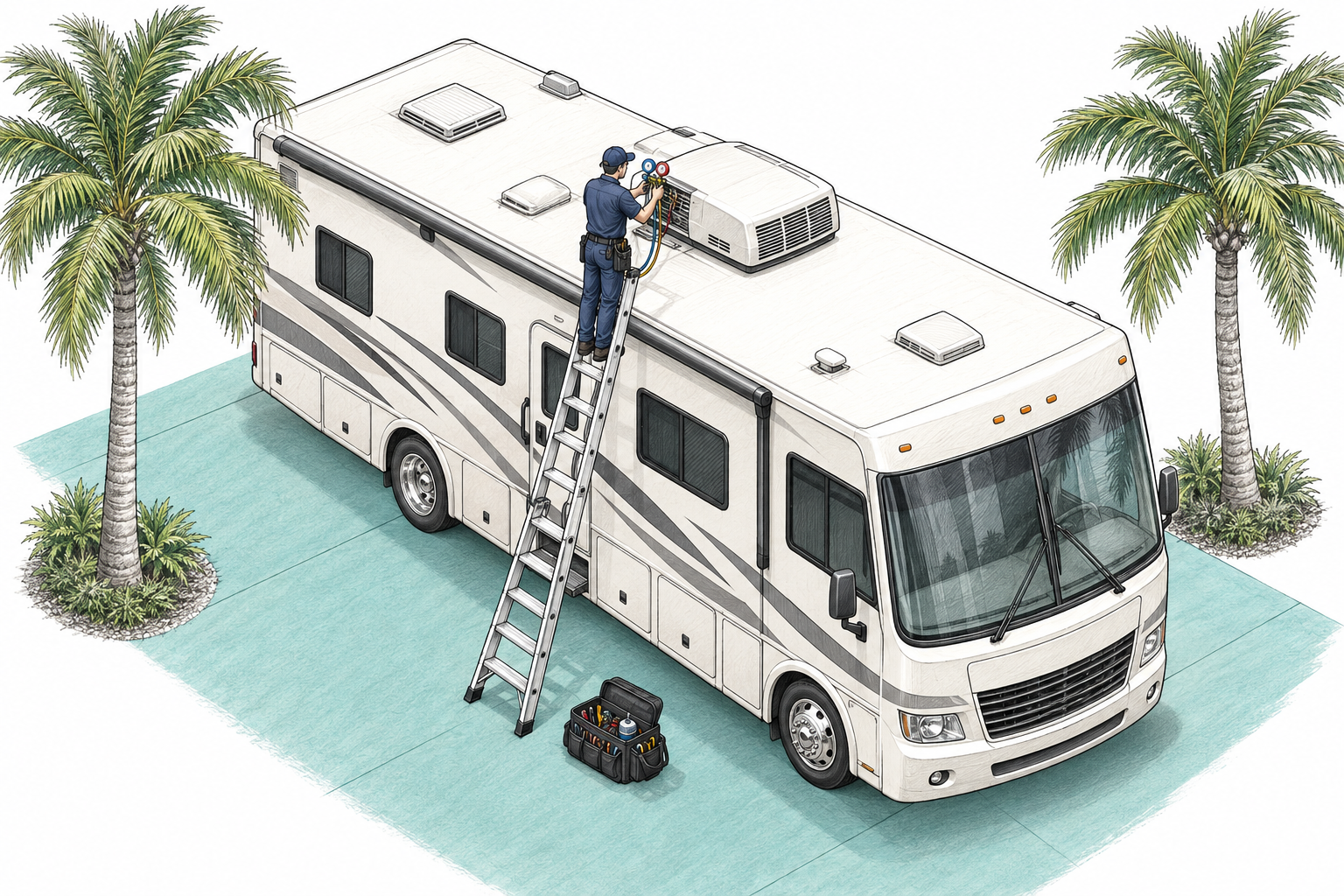
RV Repair Winter Garden provides mobile rv ac not cooling throughout Orange, Lake, and Osceola counties. Our certified technician comes to your wherever your RV is parked. Flat-rate pricing quoted before we start - no towing required.
Our certified mobile technicians provide rv ac not cooling throughout Winter Garden and all of Orange, Lake, and Osceola counties. We come to your wherever your RV is parked - no towing, no shop drop-off required.
Feat Slide Out in Winter Garden, FLFeat Ac Repair in Winter Garden, FL
Flat-rate pricing is given before any work begins. You approve the price, we do the work. Available 7 days a week, 7 AM to 8 PM.
The most common causes in Central Florida are a failed capacitor (most likely), dirty condenser or evaporator coils, a refrigerant leak, or a failed compressor. A tech can narrow it to one of these four in about 20 minutes with temperature-split and amperage testing.
The unit will run - you'll hear the fan - but the compressor won't start, so air comes out at ambient temperature rather than cold. The unit may also hum loudly on startup. A capacitance meter confirms it in under 5 minutes; a bad capacitor is a $45 to $95 part with a $185 to $250 all-in repair.
Not necessarily - in Florida heat an RV AC that is cooling but not hitting its target temperature is more likely a dirty coil or inadequate insulation in the RV than a refrigerant issue. Do a temperature split test: measure return air temp and supply air temp.
A healthy unit produces an 18 to 22-degree F split. Below 14 degrees warrants refrigerant investigation.
No - RV AC units are sealed systems and refrigerant handling requires EPA Section 608 certification. Adding refrigerant without fixing the underlying leak is also illegal and won't solve the problem. A mobile tech can locate the leak, repair it, and recharge the system on-site.
Most not-cooling diagnoses take 20 to 40 minutes on-site. We run a startup amperage test, temperature split measurement, and coil inspection. The majority of cases resolve same-day because the cause is a capacitor or dirty coils, both of which we stock parts for.
Yes - RV AC units are rated at 95 degrees F ambient. When outdoor temps hit 95 to 100 in Central Florida, a properly functioning unit will struggle to cool a poorly insulated RV below 80 degrees inside. If your unit was fine last summer and isn't keeping up this summer, the unit is losing performance; if it has always struggled, the RV insulation is the limiting factor.
This is a classic dirty condenser coil symptom. A partially clogged coil manages at cooler morning temps but can't shed heat fast enough when outdoor temps peak in the afternoon, causing the compressor to short-cycle or the unit to overheat and trip its thermal cutout.
On a 3-year-old unit, a refrigerant leak from a defective joint or vibration damage is the most likely cause for a sudden loss of cooling. Manufacturing defects on sealed-system fittings can develop leaks within 2 to 5 years. We leak-test with electronic detectors and UV dye on mobile calls.
A ceiling fan improves perceived comfort significantly - moving air feels 3 to 4 degrees cooler. Adding vents to rear bedrooms helps distribution. Neither fixes a unit that is genuinely underperforming, but both make a marginal unit noticeably more comfortable in Winter Garden summers.
Yes - check three things first: (1) the ceiling filter, which should be rinsed monthly in Florida summers; (2) the breaker, to confirm you have full 30-amp or 50-amp shore power; (3) look for ice on the return air plenum, which indicates airflow restriction. If all three check out and the unit still won't cool, call for a tech.
FAQ
Common Questions
The most common causes in Central Florida are a failed capacitor (most likely), dirty condenser or evaporator coils, a refrigerant leak, or a failed compressor. A tech can narrow it to one of these four in about 20 minutes with temperature-split and amperage testing.
The unit will run - you'll hear the fan - but the compressor won't start, so air comes out at ambient temperature rather than cold. The unit may also hum loudly on startup. A capacitance meter confirms it in under 5 minutes; a bad capacitor is a $45 to $95 part with a $185 to $250 all-in repair.
Not necessarily - in Florida heat an RV AC that is cooling but not hitting its target temperature is more likely a dirty coil or inadequate insulation in the RV than a refrigerant issue. Do a temperature split test: measure return air temp and supply air temp.
A healthy unit produces an 18 to 22-degree F split. Below 14 degrees warrants refrigerant investigation.
No - RV AC units are sealed systems and refrigerant handling requires EPA Section 608 certification. Adding refrigerant without fixing the underlying leak is also illegal and won't solve the problem. A mobile tech can locate the leak, repair it, and recharge the system on-site.
Most not-cooling diagnoses take 20 to 40 minutes on-site. We run a startup amperage test, temperature split measurement, and coil inspection. The majority of cases resolve same-day because the cause is a capacitor or dirty coils, both of which we stock parts for.
Yes - RV AC units are rated at 95 degrees F ambient. When outdoor temps hit 95 to 100 in Central Florida, a properly functioning unit will struggle to cool a poorly insulated RV below 80 degrees inside. If your unit was fine last summer and isn't keeping up this summer, the unit is losing performance; if it has always struggled, the RV insulation is the limiting factor.
This is a classic dirty condenser coil symptom. A partially clogged coil manages at cooler morning temps but can't shed heat fast enough when outdoor temps peak in the afternoon, causing the compressor to short-cycle or the unit to overheat and trip its thermal cutout.
On a 3-year-old unit, a refrigerant leak from a defective joint or vibration damage is the most likely cause for a sudden loss of cooling. Manufacturing defects on sealed-system fittings can develop leaks within 2 to 5 years. We leak-test with electronic detectors and UV dye on mobile calls.
A ceiling fan improves perceived comfort significantly - moving air feels 3 to 4 degrees cooler. Adding vents to rear bedrooms helps distribution. Neither fixes a unit that is genuinely underperforming, but both make a marginal unit noticeably more comfortable in Winter Garden summers.
Yes - check three things first: (1) the ceiling filter, which should be rinsed monthly in Florida summers; (2) the breaker, to confirm you have full 30-amp or 50-amp shore power; (3) look for ice on the return air plenum, which indicates airflow restriction. If all three check out and the unit still won't cool, call for a tech.
RV Problem? We Come to You.
Same-day service across Winter Garden and all of Central Florida. Guaranteed flat-rate pricing before we start.